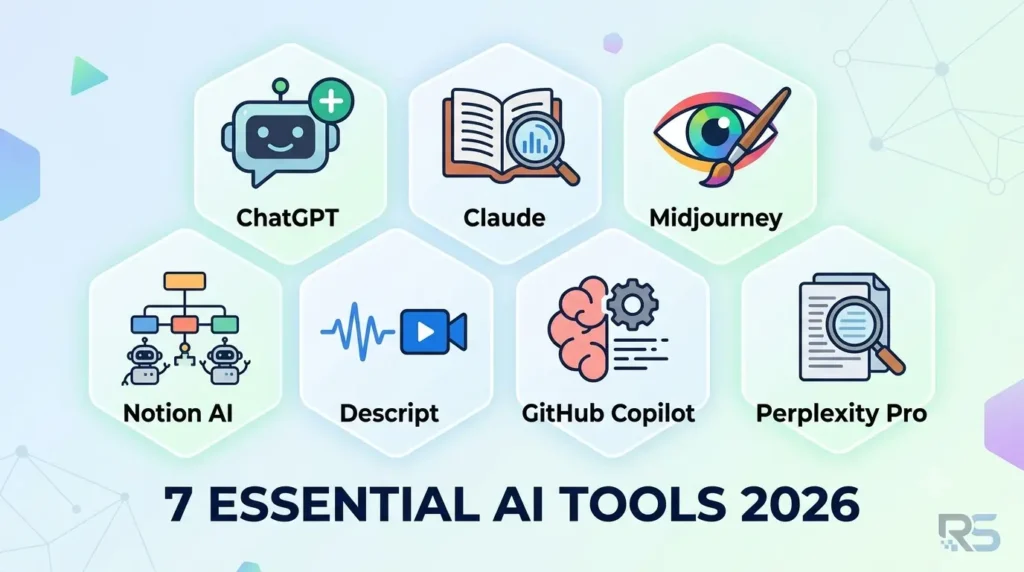
Every week brings a new “revolutionary” AI tool, and most of them quietly disappear a few months later. After testing dozens of platforms across writing, design, coding, and productivity, a short list keeps proving its worth month after month. Here are seven AI tools in 2026 that genuinely justify their price tag.
1. ChatGPT Plus / Team
OpenAI’s flagship assistant remains the most versatile all-rounder for research, drafting, brainstorming, and light coding. The Team plan adds shared workspaces, which makes it a solid pick for small agencies and startups juggling multiple projects.
2. Claude
Anthropic’s Claude has become the go-to for long-document analysis, careful reasoning, and coding assistance inside IDEs. If your workflow involves reviewing contracts, summarizing research papers, or refactoring large codebases, Claude’s long context window pays for itself quickly.
3. Midjourney
Still the benchmark for artistic image generation. The v7 model produces sharper detail and better prompt adherence than ever, and the Discord-to-web transition has made the workflow far more accessible for non-technical users.
4. Notion AI
Baked directly into your existing workspace, Notion AI saves the overhead of switching tools. Meeting summaries, action-item extraction, and database auto-fill are the features teams actually use daily rather than novelty features that get ignored.
5. Descript
For podcasters and video creators, Descript’s text-based video editing and AI voice cloning cut editing time dramatically. Filler-word removal alone can save hours per episode.
6. GitHub Copilot
Copilot has matured from an autocomplete gimmick into a genuine pair-programmer. Chat-based debugging and multi-file context awareness make it worth the monthly fee for any developer shipping code regularly.
7. Perplexity Pro
When you need sourced, current answers rather than a general chatbot response, Perplexity’s search-grounded model is faster and more reliable than manually digging through search results.
How to Choose
Don’t subscribe to everything at once. Pick one tool per bottleneck in your workflow — writing, image generation, coding, or research — and measure whether it actually saves you time after two weeks. Cancel anything that doesn’t.
Which AI tools have earned a permanent spot in your stack? Let us know in the comments.
