Disclosure: ReproSpot may earn a commission when you purchase through links on this page. This does not affect the price you pay or our editorial conclusions.
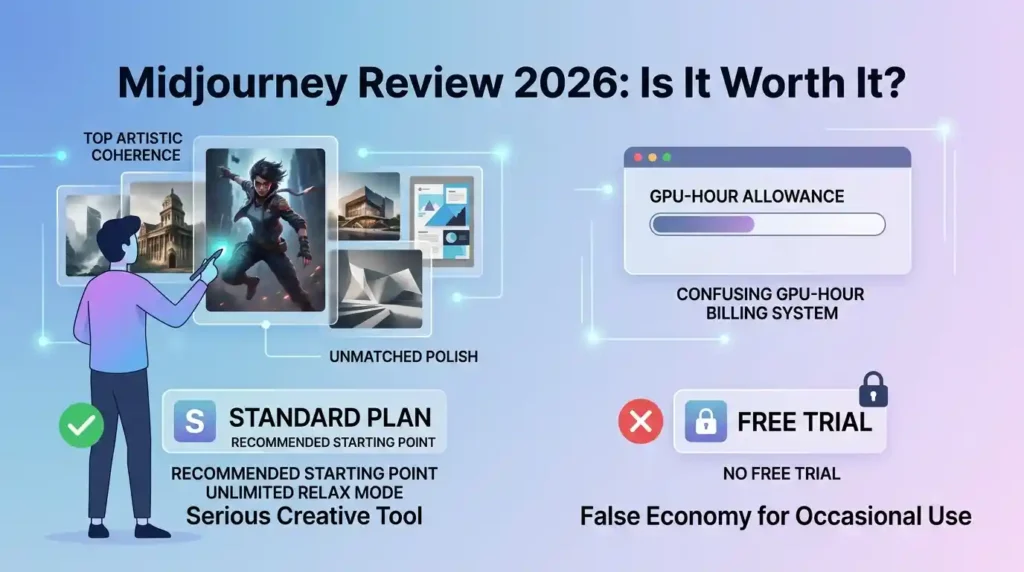
Midjourney is worth it if you value artistic quality and photorealism enough to accept its no-free-trial, GPU-hour-based pricing model — for most regular users, the $30/month Standard plan is the right entry point, not the cheaper Basic tier. It’s less compelling if you need precise, pixel-level editing control or a public API, since neither is part of the core product. This review breaks down what each plan actually buys and where the GPU-hour system catches new subscribers off guard.
Quick Verdict
- Best for: Designers, marketers, and freelancers who need consistently high-quality AI imagery and can commit to a paid plan.
- Not ideal for: Anyone needing precise image editing (Photoshop remains better) or public API access for automated workflows.
- Top strength: Community and independent benchmarks consistently rate Midjourney’s artistic coherence and photorealism ahead of competitors.
- Main limitation: No free trial, and the GPU-hour billing system takes real effort to understand before your first bill.
- Our verdict: Strong pick for serious creative use; skip Basic and start on Standard once you know you’ll use it regularly.
[CTA: Check Current Midjourney Plans → AFFILIATE LINK]
What Is Midjourney?
Midjourney is a text-to-image AI model accessible through Discord or its own web app: you write a prompt, and it generates a set of images matching that description. It’s built by a self-funded, roughly 60-person research lab with a pure subscription business model — no advertising, no freemium tier. As of 2026 the current default model is V7, with V8.1 available as the latest update adding HD 2K image support, stronger prompt understanding, and better small-detail retention.
Who Is Midjourney Best For?
- Designers and marketers generating social media graphics, ad creatives, and mood boards who value artistic polish over precise editing control.
- Freelancers and agencies producing client-facing visual content, especially once Stealth Mode (Pro plan) keeps unpublished client work private.
- Anyone who has hit the quality ceiling on free AI image tools and needs more consistent, professional-looking output.
Who Should Skip Midjourney?
Developers needing programmatic access should look elsewhere — Midjourney doesn’t offer a public API, only the Discord bot and web interface; third-party API wrappers exist but are unofficial and risk violating terms of service. Anyone needing precise, pixel-level image manipulation rather than full generations will get more mileage from Photoshop. And budget-conscious users generating fewer than 50 images a month may find free tools like Leonardo AI’s free plan sufficient without a subscription.
Key Features
Fast vs. Relax Mode
Fast mode generates images near-instantly and draws down your plan’s monthly GPU-hour allowance. Relax mode, available on Standard and above, queues generations at no additional cost — typically 60–90 seconds during off-peak hours, slower (3–5 minutes) during US business-hours peaks. Heavy users report doing the majority of exploratory work in Relax and saving Fast hours for final, time-sensitive versions.
Stealth Mode
Available from Pro plan and above, Stealth Mode keeps your generations private rather than visible in Midjourney’s public community feed — essential for freelancers and agencies working on unannounced client projects. Note that upgrading to Pro doesn’t retroactively privatize past public generations; you have to manually make older images private via the Organize page.
Image-to-Video
Midjourney can animate a generated or uploaded image into a short video, from 5 seconds up to 21 seconds extended. Video draws heavily from the same GPU-hour pool — roughly 26 minutes of GPU time per HD video batch versus about 1 minute for a still image — so heavy video use burns through your monthly allowance fast.
Midjourney Pricing
Pricing checked: July 2026. No free trial exists — the Basic plan is the cheapest way to generate a single image. Software pricing changes; verify current numbers on Midjourney’s official plan comparison page before subscribing.
| Plan | Best For | Key Consideration |
|---|---|---|
| Basic ($10/mo, $8 annual) | Casual testing, 5–10 images/week | ~3.3 fast GPU hours (~200 images), no Relax Mode |
| Standard ($30/mo, $24 annual) | Regular users — the recommended default | 15 fast hours plus unlimited Relax Mode generation |
| Pro ($60/mo, $48 annual) | Freelancers/agencies needing privacy | 30 fast hours, adds Stealth Mode and more concurrent jobs |
| Mega ($120/mo, $96 annual) | Studio-level volume and video production | 60 fast hours for the heaviest users |
Extra Fast hours beyond your plan’s allowance cost $4 each and, unlike your monthly allocation, don’t expire. Annual billing (paid upfront for the year) saves 20% across every tier, and it’s the only discount Midjourney offers — no seasonal promotions or referral credits.
[CTA: View Current Midjourney Pricing → AFFILIATE LINK]
Pros and Cons
Pros
- Consistently rated the top tool for artistic coherence and photorealism
- Unlimited Relax Mode on Standard and above removes hard monthly image caps
- All paid plans include general commercial usage rights
- Extra Fast hours don’t expire once purchased, unlike the monthly allocation
Cons
- No free trial — the $10 Basic plan is the only way to test the tool
- GPU-hour billing is genuinely confusing for new subscribers
- No public API — Discord bot or web app only
- Making previously public generations private requires manual, retroactive action
Frequently Asked Questions
Which Midjourney plan should I actually start with?
Standard at $30/month, for most people. Basic’s 3.3 fast hours run out within the first week of regular use, and the jump to unlimited Relax Mode on Standard changes the value equation more than the price gap suggests — you stop worrying about running out entirely.
Can I use Midjourney images commercially?
Yes, all paid plans include general commercial usage rights. The one exception: companies with over $1 million in gross annual revenue are required to subscribe to Pro or Mega rather than Basic or Standard for commercial use.
Why do I need Stealth Mode?
By default, Midjourney generations are visible in the public community feed. If you’re working on unannounced client projects, competitive concepts, or anything confidential, Stealth Mode (Pro plan and above) keeps your generations private.
Is there really no way to try Midjourney for free?
Correct — the free trial via Discord was removed in 2023 and hasn’t returned. If you want to evaluate AI image quality without paying anything first, free tools like Leonardo AI’s free tier are a reasonable way to confirm the category fits your workflow before committing $10 to Midjourney.
Final Verdict
Midjourney earns its reputation as the quality leader in AI image generation, and for designers, marketers, and freelancers who need consistently polished output, the subscription pays for itself quickly. The real decision isn’t whether Midjourney is worth it — it’s which plan matches your actual usage. Basic is a false economy for anyone using it regularly; Standard’s unlimited Relax Mode is where the value genuinely clicks for most people. Only step up to Pro if client privacy specifically matters, and reserve Mega for studio-level volume. The lack of a free trial is a legitimate frustration, but if you’ve confirmed AI image generation fits your workflow through a free alternative first, Midjourney remains the strongest paid option available.
[CTA: Check Current Midjourney Plans → AFFILIATE LINK]
